La Fiscalía General de la Nación judicializó a un pasajero de bus de servicio público que fue sorprendidos portando marihuana cuando se movilizaban por vía del Valle del Cauca.
La captura se presentó en la vía que de La Paila conduce a Armenia (Quindío), jurisdicción de Sevilla. En esta zona fue capturado en flagrancia Luis Carlos Mendoza, de 29 años de edad, cuando portaba 6.170 gramos de marihuana mientras se movilizaba en un bus de servicio público.
La fiscalía imputó el delito de fabricación, tráfico o porte de estupefacientes, ninguno de los cuales fue aceptado por los procesados, el cual debe cumplir medida de aseguramiento en centro carcelario.
El bus escolar se desplazaba desde la Institución Educativa Laguna de Ortices y llevaba a los niños de regreso a sus casas.
Noticias Colombia.
Un fatal accidente se registró durante la tarde de este martes en las vías del departamento de Santander, luego que un bus escolar rodara por un abismo de más de 200 metros.
La emergencia se registró más exactamente el sector conocido como el Alto de San Pedro, frente a la Laguna de Ortices.
El bus de transporte escolar llevaba a los niños desde el colegio hasta sus casas, después de finalizar las clases.
#TRAGEDIA En san andres santander donde un bus escolar se presipito a un abismos sobre la 1:30 de este martes, en el sector conocido como el alto de san pedro a la altura de la laguna de ortises en el echo al menos 7 menores habrian fallecido y 17 heridos. pic.twitter.com/t22rLBfXPx
— LO QUE PASA EN BUCARAMANGA Y COLOMBIA. COM (@Loquepasaenbuca) March 22, 2022
Hasta el momento se sabe que hay seis menores que perdieron la vida y más de 15 heridos, que fueron trasladados al Hospital San José, del municipio.
Por ahora no se ha determinado la causa del siniestro vial, sin embargo hipótesis señalan que se deberían a una falla mecánica.
La comunidad y los organismos de socorro de San Andrés y de Molagavita acudieron al sector para realizar el rescate.
Yo misma recorrí esa vía. Un completo asco. Miren ustedes mismos, pavimentada a pedazos, de a 15 segundos por trozo de asfalto… lo demás es trocha, cuando llueve es muchísimo más peligroso y la neblina por zonas es permanente. @MAguilarHurtado sin palabras Gobernador. pic.twitter.com/UA1hmpzkty
— Rosa Juliana Herrera Pinto🐾👣 (@juliherrerap) March 22, 2022
No hay lesionados y si daños en algunas fachadas de viviendas y en otro carro particular. El bus se fue en reverse por la calle empinada.
No hay lesionados y si daños en algunas fachadas de viviendas y en otro carro particular. El bus se fue en reverse por la calle empinada.
Noticias Pasto.
Este domingo se registró un accidente de tránsito en el sector Aire Libre en Pasto, cuando un bus se ‘rodó’, se fue en reversa por una calle empinada, y terminó frenándolo el antejardín de una casa y la fachada de otra.
El reporte extraoficial hasta las 4:00 p.m., es que se trataría de una falla mecánica del vehículo de transporte público.
El autobús, que estaba al parecer parqueado, se fue de reversa, golpeó un carro y luego dos viviendas que resultaron con algunos daños.
El caso registrado este domingo en Pasto.
Según reporta Emergencias Pasto, no hubo personas lesionadas.
En el momento del accidente, la vía estaba solitaria.
Habitantes del sector dicen sentir temor que esto vuelva a ocurrir, porque en días de semana, llega la gente a parquear frente a su casa, a subir o bajar de sus carros, motos, ingresan o salen con niños.
El bus de Supertaxis que permaneció más de una hora, casi colgando, en el lugar, tendrá que ser llevado a patios para revisión y que se determine si fue falla mecánica y cómo se ha cumplido con el mantenimiento y revisión.
Cuando se estacionen en estas calles empinadas, piden a los conductores poner la debida protección para evitar siniestros como este.
Se confirmó que el conductor, un hombre de 39 años de edad, y por lo menos cuatro pasajeros más, murieron tras el aparatoso accidente, y hubo varios heridos más en vías del Magdalena.
Se confirmó que el conductor, un hombre de 39 años de edad, y por lo menos cuatro pasajeros más, murieron tras el aparatoso accidente, y hubo varios heridos más en vías del Magdalena.
Noticias Caribe.
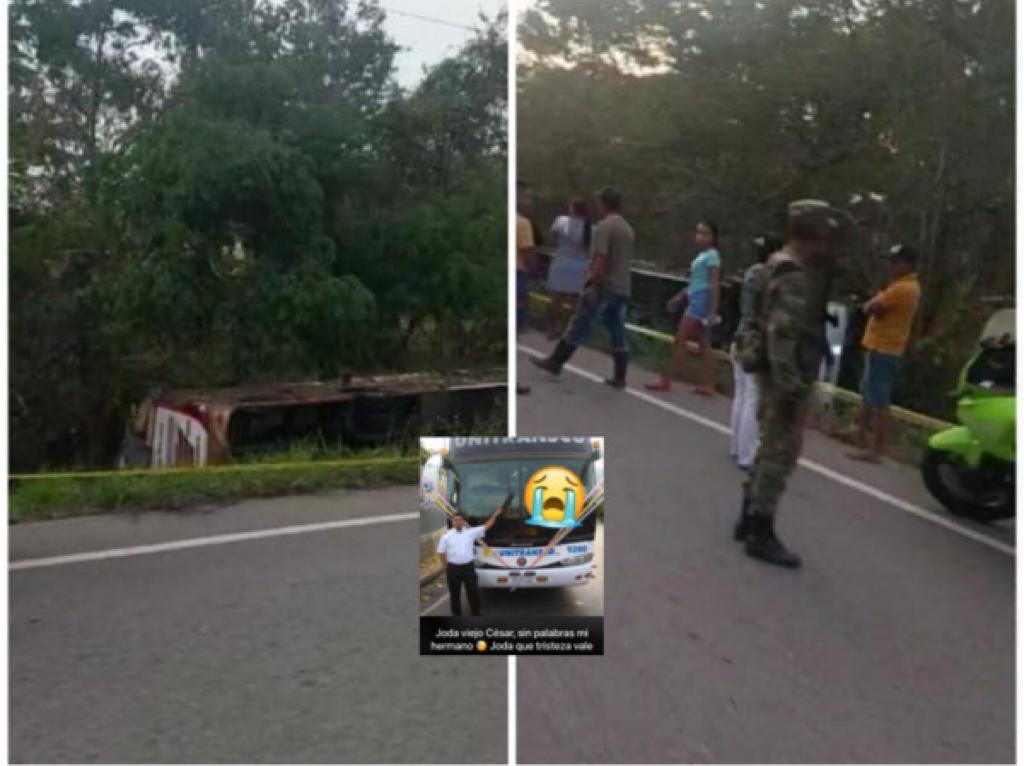
Como César Mauricio Vega C., de 39 años de edad y padre de dos hijos, fue identificado el conductor que este domingo murió en un aparatoso accidente de tránsito en la vía que de Pueblito Los Andes conduce a Santa Ana en Magdalena. El volcamiento fue a las 4 de la madrugada.
En el bus iban unos 32 pasajeros, salieron de Barranquilla el sábado a las 10 de la noche, con destino a Mompox.
El conductor falleció en el sitio. Otros cuatro pasajeros también.
De los pasajeros reportan varios lesionados, que han sido trasladados y remitidos a centros médicos de esta zona entre Magdalena, Atlántico y hasta Bolívar.
Ocurrió a 5 kilómetros de los Andes, «se salió de la vía», el reporte es de al menos cinco personas fallecidas.
El bus, placa WEM029, estaba afiliado a Unitransco, es de Expreso Brasilia.
Por varios minutos tuvieron que hacer labores para extraer a los lesionados que habían quedado atrapados en el bus.
Hasta ahora se reporta que sería el bus el único implicado en el siniestro, es decir, que terminó saliéndose de la vía y volcándose. No descartan exceso de velocidad o posible microsueño, aunque la inspección determinará si fue alguna de esas causas o una falla mecánica.
Autoridades recomiendan precaución en las vías del país, además por ser este puente festivo y miles de viajeros de un lado a otro.
Evitar conducir si no han descansado bien
No conducir bajo los efectos de bebidas embriagantes o sustancias alucinógenas
José Ángel, motorizado que perdió la vida en el accidente.
José Ángel, el motorizado que perdió la vida un día antes de su cumpleaños.
Noticias Barranquilla.
Un accidente de tránsito cobró la vida de un motorizado que se movilizaba por la Avenida Circunvalar en el sector que conecta con la Vía 40.
Como José Ángel Noriega fue identificado el joven de 29 años de edad, que resbaló en su vehículo de placas YRS 200 y chocó contra la parte trasera de un bus de servicio privado, el cual se hallaba, al parecer, estacionado en la rotonda del monumento de ‘La Ventana al Mundo’.
José Ángel Noriega, joven que falleció en accidente de tránsito.
Joisé Ángel se desplazaba en su moto con destino a su vivienda cuando ocurrió lo inesperado: Perdió el control del vehículo que se movilizaba a unos 60 kms por hora.
Una persona grababa con su teléfono móvil el recorrido de la motocicleta y en las imágenes se alcanza a ver cuando el sujeto cae y su cuerpo termina debajo del automotor.
Motortizado que chocó contra parte trasera de vehículo.
Autoridades de tránsito se desplazaron hasta el sitio para verificar el accidente registrado en horas de la noche del viernes.
Policías de tránsito en el lugar de los hechos.
La moto quedó debajo del bus de servicio privado.
Sobre Jose Ángel se conoció que este sábado 12 de marzo cumplía 29 años de edad.
Motorizado que murió en el accidente.
Era un apasionado a las motos y trabajaba precisamente en una escuela de conducción en el cargo de instructor.
Sus familaires, amigos y conocidos lamentan su muerte.
Walter R. Mears, who for 45 years fluidly and speedily wrote the news about presidential campaigns for The Associated Press and won a Pulitzer Prize doing it, has died. He was 87.
“I could produce a story as fast as I could type,” Mears once acknowledged — and he was a fast typist. He became the AP’s Washington bureau chief and the wire service’s executive editor and vice president, but he always returned to the keyboard, and to covering politics.
Mears died Thursday at his apartment in Chapel Hill, North Carolina, eight days after being diagnosed with multiple forms of cancer, said his daughters Susan Mears of Boulder, Colorado, and Stephanie Mears of Austin, Texas, who were with him.
They said he was visited on his last night by a minister, with whom he discussed Alf Landon, the losing Republican presidential candidate in 1936, a year after his birth.
Mears’ ability to find the essence of a story while it was still going on and to get it to the wire — and to newspapers and broadcasters around the world — became legend among peers. In 1972, Timothy Crouse featured Mears in The Boys on the Bus, a book chronicling the efforts and antics of reporters covering that year’s presidential campaign.
Crouse recounted how, immediately after a political debate, a reporter from The Boston Globe called out to the man from AP: “Walter, what’s our lead? What’s the lead, Walter?” The question became a catchphrase among political reporters to describe the search for the most newsworthy aspect of an event — the lead. “Made me moderately famous,” Mears cracked in 2005.
FILE – In this 1976 file photo, Associated Press Special Correspondent Walter R. Mears, right, talks with presidential candidate Jimmy Carter in Concord, N.H., before the New Hampshire Primary.
It was a natural question. Mears had to bang out stories about campaign debates while they were still underway. Newspaper editors would see his lead on the wire before their own reporters filed their stories. So it was defensive for others on the press bus to wonder what Mears was leading with, and to ask him.
Early in his Washington career, he was assigned to write updates on the 1962 congressional elections. His bureau chief asked a senior colleague to size up how Mears worked under pressure and report back. “Mears writes faster than most people think,” the evaluator wrote, then, tongue in cheek, “and sometimes faster than he thinks.”
“Walter’s impact at the AP, and in the journalism industry as a whole, is hard to overstate,” said Julie Pace, AP executive editor and senior vice president. “He was a champion for a free and fair press, a dogged reporter, an elegant chronicler of history and an inspiration to countless journalists, including myself.”
Kathleen Carroll, a former AP executive editor, said he taught generations of journalists “how to watch and listen and ask and explain.”
“Walter was also a wonderful human being,” she said. “He loved his family — being a grandfather was one of the great joys of his life. He loved golf and the Red Sox, in that order. He loved politics and he loved the AP.”
Mears didn’t seem to mind being known as a pacesetter. “I came away with a slogan not of my making, but one that stuck for the rest of my career,” he recalled in his 2003 memoir, Deadlines Past. Over four decades, Mears covered 11 presidential campaigns, from Kennedy-Nixon in 1960 to Bush-Gore in 2000, as well as the political conventions, the campaigns, debates, the elections and, finally, the pomp and promise of the inaugurations.
In tribute, Jules Witcover, who covered politics for The Sun in Baltimore, said Mears combined speed and accuracy with an eye for the telling detail.
“His uncanny ability to cut to the heart of any story and relate it in spare, lively prose showed the way for a generation of wire service disciples, and he did so with a zest for the nomad’s life on the campaign trail,” Witcover said.
FILE – President Bill Clinton is interviewed by Associated Press reporters, White House correspondent Terry Hunt, second from right and AP special correspondent Walter Mears, aboard Air Force One en route to Brunei, on Nov. 14, 2000.
At other times in his career, Mears served AP as Washington bureau chief and as the wire service’s primary news executive, the executive editor in the New York headquarters. But he missed writing and went back to it.
He left once, to be Washington bureau chief for The Detroit News, but returned to AP nine months later. “I couldn’t take the pace,” he said. “It was too slow.”
In 1977 he was awarded a Pulitzer Prize for his work covering the election in which Democrat Jimmy Carter defeated a sitting president, Gerald R. Ford, who had inherited his office through the resignation in disgrace of Richard M. Nixon.
It was the Pulitzer, not the Crouse catchphrase, for which Mears thought he would be remembered. Asked to address a later crop of Pulitzer winners, he told them they would never have to wonder what would be the first words of their obituaries: They would be, he said, “Pulitzer Prize-winning.”
Winning his Pulitzer, Mears said, was “the sweetest moment in a career that is like no other line of work.”
In his lead paragraphs, Mears captured the essence of events, not just the words but the music.
When the 1968 Democrats, in a convention held in the midst of antiwar rioting on the streets of Chicago, finally chose their nominee, he wrote: “Hubert H. Humphrey, apostle of the politics of joy, won the Democratic presidential nomination tonight under armed guard.”
When, earlier that year, a gunman killed John Kennedy’s brother: “Robert F. Kennedy died of gunshot wounds early today, prey like his president brother to the savagery of an assassin.”
And, in 1976, when former peanut farmer Carter took the presidency from its accidental occupant: “In the end, the improbable Democrat beat the unelected Republican.”
Said Terry Hunt, former AP White House correspondent and deputy bureau chief in Washington: “You can’t talk about Walter without using the word legendary. He was a brilliant writer, astonishingly fast, colorful and compelling.”
David Espo, former special correspondent and assistant Washington bureau chief agreed. “No one ever wrote faster or with more clarity, nor worked harder and made it look easier than Walter did,” he said. “He took care to mentor those less talented than he, in other words, all of us.”
Mears was born in Lynn, Massachusetts, and grew up in Lexington, the son of an executive of a chemical company. He graduated, Phi Beta Kappa, from Middlebury College in Vermont in 1956 and within a week joined the AP in Boston.
In those days, news was written on typewriters and transmitted on teletypes. “They were slow and they clattered,” Mears once wrote, “but the din was music to me.”
His first assignment was far from the din. He single-handedly covered the Vermont Legislature. “It was fun covering a citizen legislature with a representative from every hamlet in the state” — 276 of them, he recalled years later, including one elected by his townspeople to keep the fellow from being eligible for welfare.
Mears covered John F. Kennedy in 1960 whenever Kennedy campaigned in New England and covered Barry Goldwater’s hapless race against Lyndon Johnson four years later. He was back at it every presidential year, even after he retired in 2001.
On election night, 2008, he wrote an analysis of Barack Obama’s victory, and the challenge before him.
“Obama is the future,” he wrote, “and it begins now, in troubled times, for a president-elect with a costly agenda of promises that would be difficult to deliver in far better economic circumstances.”
No cheerleading from Mears there. He didn’t believe in reporters expressing political opinions and he kept his own to himself. Although he got to know the candidates he covered, sometimes shared after-hour drinks and played golf with them, he always addressed them by their titles.
He considered a distance between newsperson and newsmaker to be appropriate. He once explained: “I can’t really say I ever felt close to any of them, maybe because I always felt that there’s a line there, there’s sort of a reserve that I think needs to be maintained because you’re not covering a friend. You’re covering somebody who’s trying to convince the American people to give him the most important job they’ve got at their command.”
After retiring, Mears taught journalism for a time at the University of North Carolina and made his home there, in Chapel Hill.
His wife, Frances, died in January 2019. His first wife and their two children were killed in a house fire in 1962. Mears directed that a portion of his ashes be distributed with Frances’ remains and the rest in Massachusetts with those of his first wife and two children lost in the fire.
The Metropolitan Police managed to capture the man who on February 17 attacked a bus of the MIO transport system.
The authorities indicated that at the time of investigating his identity, the detainee had been in jail three times and had an arrest warrant for other crimes.
(You may be interested: With a firearm they assassinate an escort of a candidate for Congress, in Tuluá)
It should be remembered that the assault on the bus was recorded on video. In it, a man who was traveling on a motorcycle invaded the exclusive lane of the system, and later attacked part of the glass of an articulated bus.
The police institution explains through a statement that the video, viralized on social networks, served for the authorities to carry out a thorough investigative work that had the support of the Prosecutor’s Office, the Mayor’s Office of Cali and the community in general.
To this was added a $10 million reward to find the person responsible.
“In seven days, an average of 100 judicial police activities were carried out, which included interviews, verification of information, examinations, among other actions for the collection of material evidence,” said General Juan Carlos Montes, commander of the Metropolitan Police of Cali.
(Also read: Scare due to electrical damage in the Departmental Library)
The uniformed officer maintained that apparently, the detainee was part of a criminal structure that would be at the service of another criminal organization with incidence in Buenaventura.
The captured person, 31 years old, has within his criminal record crimes such as theft, illegal possession of weapons, attempted aggravated homicide and forgery in a document. These crimes had represented him three entries in jail.
The captured was left at the disposal of the competent authority to resolve his legal situation. At the moment, the investigation against him is progressing for disturbance of the transport service and damage to another’s property.
El sujeto fue capturado por la Policía había estado en prisión en tres ocasiones y «para la fecha de los hechos pertenecía a una estructura delincuencial que a su vez estaría al servicio de otra organización criminal con injerencia en el municipio de Buenaventura». Además, estaría involucrado en la muerte de un uniformado del Gaula.
El sujeto fue capturado por la Policía había estado en prisión en tres ocasiones y «para la fecha de los hechos pertenecía a una estructura delincuencial que a su vez estaría al servicio de otra organización criminal con injerencia en el municipio de Buenaventura». Además, estaría involucrado en la muerte de un uniformado del Gaula.
Noticias Cali.
31 años de edad tiene el sujeto que habría atacado con un puño una de las ventanas de un bus del MIO el pasado 17 de febrero, el hombre había invadido el carril exclusivo en su motocicleta y terminó reaccionando violentamente luego de que le reclamaran.
Le pegó un puño al bus del MIO, y quebró una de las ventanas.
Ofrecían 10 millones de recompensa.
La imagen de dichos hechos se volvieron virales y las autoridades ofrecieron una recompensa de hasta 10 millones de pesos para dar con su paradero.
Tiene un importante prontuario criminal
Durante la noche de este jueves 24 de febrero desde la Policía Metropolitana de Cali las autoridades confirmaron su captura.
Sin embargo lo que más ha llamado la atención es el gran prontuario criminal que tendría éste sujeto.
Precisaron que se logró materializar la «orden de captura por concierto para delinquir con circunstancias de agravación punitiva, homicidio y porte ilegal de armas de fuego» luego de varias investigaciones e injerencia de la comunidad.
Así mismo, precisaron que pudieron establecer que el hombres ya tenía orden de captura vigente por concierto para delinquir con circunstancias de agravación punitiva, homicidio y porte ilegal de armas de fuego.
Lo anterior, «por hechos ocurridos en el año 2017 en el sector de Menga, cuando fue asesinado un policía adscrito al Gaula de la Policía Valle», informaron.
#TuDenuncia. Iba por el carril exclusivo del MIO. En el centro de Cali este jueves.
Por otro lado, las autoridades manifestaron otro detalle que ha llamado la atención.
Indican que para el momento en el que se presentó el incidente con el bus del MIO, el hombre «pertenecía a una estructura delincuencial que a su vez estaría al servicio de otra organización criminal con injerencia en el municipio de Buenaventura».
El hombre tiene un importante prontuario criminal, según las autoridades.
A lo que se le unen además de los anteriores, delitos como homicidio agravado en grado de tentativa, hurto, porte ilegal de armas de fuego y uso de documento falso.
Metrolínea announced that from this Monday, February 21, the first electric bus will roll through the streets of Bucaramanga and its metropolitan area.
(We recommend: The key man in the scandal that splashes Rodolfo Hernández)
The vehicle will enter into operation for the Integrated Metroline Mass Transportation System, for a period of six months, “with the purpose of testing this technology so that users, drivers and authorities realize the benefit it brings to sustainable mobility,” they say from the system.
To achieve this first electric bus, a strategic alliance between Metrolínea SA, the Mayor of Bucaramanga, the Electrificadora de Santander (ESSA Grupo EPM), the company BYD, the Metropolitan Area of Bucaramanga (AMB) and the transport concessionaire Metrocinco Plus.
(Also: Rains cause an emergency due to a product spill in the oil field)
These entities contributed economic, technical and human resources so that today citizens can enjoy a new mobility.
The electric bus BYD brand is 2016 model, articulated, and has already been in operation as a pilot in the cities of Bogotá, Pereira and now reaches Bucaramanga.
“We want our users, operators and the metropolitan area of Bucaramanga to know this technology, use it and recognize the benefits it can bring in terms of mobility, air quality and therefore quality in the health of citizens,” said the manager of Metroline, Emilcen Jaimes Caballero.
«¿Por las placas no lo ubican?» se preguntan muchos sobre el motorizado, otros aplauden que la Alcaldía atienda estos casos.
«¿Por las placas no lo ubican?» se preguntan muchos sobre el motorizado, otros aplauden que la Alcaldía «le meta mano a estos actos despreciables» dicen. Hay alerta en la ciudad por el alto nivel de intolerancia y de incumplimiento a las normas de tránsito, de convivencia y de cultura ciudadana.
Noticias Cali.
En la 15 con 20 en pleno centro de Cali una escena aunque insólita muy repetida desde hace unas semanas en Cali: intolerancia disparada, un motorizado circulando por el carril exclusivo del MIO y ante un incidente con el conductor del bus azul, se abjó y le partió el vidrio.
El hombre, se bajó de su moto y llegó directo a la ventanilla del conductor del MIO.
«Ay Dios, viene enojado», dijo una pasajera, no se equivocó: mano empuñada, golpe al vidrio y lo partió.
Lanzó un golpe con el puño cerrado a la ventana.
Todas las esquirlas volaron al rostro del conductor.
Luego, el sujeto sin decir más nada, se subió en su motocicleta y siguió.
Metros más adelante se salió del carril y siguió el problema, mientras usuarios del bus llamaban a la policía, que no está claro por qué no llegó ninguna patrulla; tampoco tránsito, la gente trataba de grabarle las placas a la moto para que se vieran más claras, pero el motorizado se voló.
Recompensa
«Ayúdanos a identificar a este desadaptado e irresponsable que pone en peligro vidas valiosas», anunció el alcalde Jorge Iván Ospina.
La recompensa que ofrece la Alcaldía de Cali.
Hay una recompensa de hasta 10 millones de pesos para quien de información que permita encontrar al motorizado, que sería judicializado.
Ayúdanos a identificar a este desadaptado e irresponsable que pone en peligro vidas valiosas pic.twitter.com/pkIvZitH7a
Aunque algunos han criticado que se tenga que dar recompensa «cuando ya deberían tenerlo identificado», otros aplauden que la Alcaldía intervenga con severidad en estos casos.
¿Qué está pasando en Cali?
Luego de conocerse esas lamentables imágenes los caleños no demoraron en rechazar y denunciar el lamentable episodio.
Riñas o disputas entre ciudadanos, agresiones a agentes de tránsito en medio de operativos (van 7 funcionarios lesionados) o conductores de ambulancia agresivos no paran.
Situaciones que acompañadas de los hurtos y demás hechos violentos, infortunadamente se volvieron costumbre en la ciudad.
El mal comportamiento ciudadano también va disparado, y ha ido minando la convivencia ciudadana y con la institucionalidad.